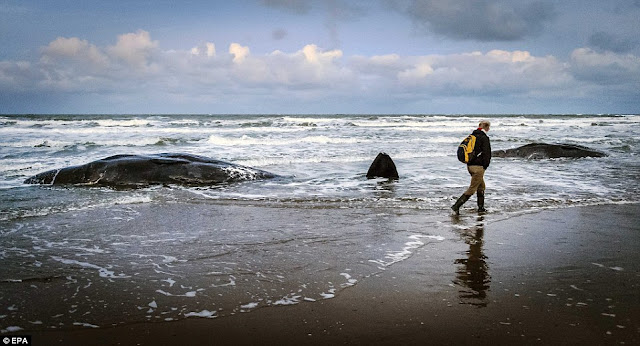
Can whale strandings be predicted weeks in advance?

Research by Capt. David Williams (Deafwhale Society, Inc.) indicates that the beachings of offshore whales are the result of a barotraumatic injury following the exposure to potent pressure changes generated above the epicenter of certain SEAQUAKES.

Friday, June 5, 2009

Beachings of whales and dolphins predicted!!!!!

A rash of whale and dolphin strandings are predicted to occur in the Gulf of Mexico and around Florida and as far north as Cape Hatteras, North Carolina.


A magnitude 7.3 earthquake occurred offshore of Honduras on Thursday, May 28, 2009 at 02:24:45 AM local time. The epicenter was near 16.733°N, 86.220°W. The depth of focus was constrained by location program to be a maximum of 10 km below the surface of the sea.


This event was the most powerful shallow-focused seaquake to occur in the last 20 years. Rapid changes in hydrostatic pressure near the epicenter and will surely injured (barotrauma) many whales and dolphins of different species. Where the survivors might beach depends solely of the flow of the surface currents from the epicenter. The general path of the current from the waters off Honduras is north through the western Caribbean into the Yucatan Channel and into the Gulf of Mexico by way of the Loop Current.


http://www.csc.noaa.gov/crs/definitions/loop_current.html


Based on the latest SST data, the Loop Current intrudes into the GOM to about 28 degrees north and then turns back south toward Cuba before it swings north again.


http://fermi.jhuapl.edu/avhrr/gm/averages/09jun/gm_09jun06_0241_multi.png


As of 2 AM (Miami time) on Saturday morning, June 6th, the injured whales should be in the Gulf of Mexico near 28 degrees N about 200 miles due west of Clearwater, Florida. These whales should arrive somewhere near Key West Florida on or about June 12. I don't expect them to strand right away unless there is a lot shoreward wind. Best guess is that they will travel northeast with the Florida Current, skirt along the Florida Keys to Miami and join the Gulf Stream and head north as far as Cape Hatteras, North Carolina.


In fact, if the wind and currents hold steady, Cape Hatteras looks like the best spot for a beaching. Since seaquake-injured pods travel downstream about 100 miles per day and are at sea on average of about 25 days, a typical stranding should be expected near Cape Hatteras sometimes around the 23rd day of June.


It all depends on how badly the animals were injured in the seaquake. Seriously injured whales might start hitting the beach near Key West on June 12th. Many carcasses might drift into shore.


(Update 16 June)

Let there be no doubt--this seaquake was nasty and it occurred in an area where many offshore whales feed. However, the surface currents are tricky to predict without a lot of help. I noticed the other day that there is also the YUCATAN CURRENT that must be plugged into the prediction.

http://oceancurrents.rsmas.miami.edu/caribbean/yucatan.html

Without the latest satellite data, which I do not have the time to gather, the possible stranding site is going to be hard to call. There were also 5 or 6 major aftershocks. The latest on 15 June. These aftershocks were strong enough to injure whales so this increases the time that a pod might strand to as far out as the last week in July.

These events are unique and will surely injure whales. The only question in my mind is whether the surface currents will keep the injured animals offshore until the sharks have had time to take them all, or will the surface currents dump them ashore? Only time will tell.

I rate the chance of a likely stranding as an 8 out of 10--high indeed!


Update 9 AM (Miami) Wednesday, 23 June 2009:

Tropical storm Ana located offshore of North Carolina could stir/blow the injured pod out to sea? Timing is everything now. It all depends on where the injured whales are at this exact moment.

Here's the link on the storm!


Capt. David Williams

3 AM Miami time, 6 June 2009


Monday, May 4, 2009

chance of pilot whale mass stranding in New Zealand

I am issuing a mass stranding alert for Golden Bay, New Zealand. The stranding is likely to occur sometime around 17 May 2009.

The big problem with this alert is the direction of the current in the Tasman Sea. An injured pod could be directed back toward Tasmania or toward New Zealand. Another tough call.

Posted Tuesday, 5 May 2009
Capt. David Williams
Deafwhale Society

Wednesday, April 29, 2009

chance of whale stranding in the Canary Islands

There is an increased chance that a pod of offshore dolphins will strand in the Canary Islands sometime around the end of May.

Friday, February 6, 2009

another whale stranding prediction comes true

Captain David Williams, president of the Deafwhale Society correctly predicted another whale stranding a month in advance and marine mammal scientific community (supported by the US Navy) and those who rescue whales for a public donation continue to ignore his work.

Her are the verifiable facts:

On 30 December 2008, a month before the stranding occurred, the Deafwhale Society posted on their blog that there was a possibility of a stranding on Cape Cod by the end of January.

http://deafwhale.blogspot.com/2008/12/chance-of-stranding-on-cape-cod-by-end.html


This prediction came true on 4 February, only 4 days off target.

http://www.boston.com/lifestyle/green/greenblog/2009/02/dramatic_rescue_of_dolphins_an.html

Could it be that Capt. Williams knows something about whales strandings that the rest of the worlds does not know? It sures looks that way . . .

Thursday, January 22, 2009

The prediction we made in December comes true in January!

The Deafwhale Society's "SEAQUAKE THEORY" predicted a pod of whales would strand in mid January on a beach in Tasmania or New Zealand. As you can read below, we were not 100% sure exactly where the pod might end up because of the many storms at sea on the approach to Tasmania. (surface currents, controlled by the winds, determine the stranding site)

http://deafwhale.blogspot.com/2008/12/pod-of-whales-predicted-to-strand-mid.html

Our prediction came true on ~20 January when ~45 sperm whales were discovered beached off Tasmania's north-west coast. How long they had been on the beach before discovery was not determined.

http://www.examiner.com.au/news/local/news/disasters-accidents/only-5-survive-mass-beaching-high-tide-marks-best-time-for-rescue/1415191.aspx

Whale scientists and non-profit groups who supposedly rescue whales, want the public to believe a ridculous story that the wind caused the beaching:

http://www.timesoftheinternet.com/40200.html

They want the public to think that whales are brainless critters that wander too close to land and strand because of some stupid mistake. They also want to public to believe that these animals can be saved by pushing them back off the beach. The reason is simple. Marine mammal scientists, and those that rescue whales for public donations, are afraid if it becomes known that whale strandings are cause by undersea earthquakes and volcanic eruptions, then the public will not be willing to donate any more money or waste any more public funds to study the mystery of why whales mass strand.

As long as these whales scientists can continue to scam the public, then they can milk the situation for more money. This has been going on for decades and not likely to end until the crooked scientists are exposed via of an informed public.

Whale scientists have been scrathing their heads since the days of Aristotle claiming that they have no idea why pods of whales fling themselves ashore. Jesus H. Christ, the only plausible answer is that they are previously injury by rapid changes in water pressure generated by a catostropic event of nature such as a undersea volcanic erruption or seafloor earthquake in the seabed (or by navy sonar).

Barotrauma in air breathing marine mammals ain't rocket science---it's bloody common sense. If the surrounding water pressure changes too excessively or too rapidly, diving mammals get injured! How could a marine mammal scientists get his degree and not be aware of the potential for barotrauma? These egotists jerks have been fooling the public for decades just so they can continue to rob money to study the mystery of whale strandings.

In other words, there would be a lot less money for the scientists and non-profit groups if the mystery was solved. The money is in keeping the mystery alive and in continuing to rush to the beach and take more tissue samples and do more medical examinations.

Read the newspapers--a million whales have been examined and ten million tissue samples taken to the lab for detail analysis and the dumb scientists are still scratching their heads and wanting to collect more samples and get more money from the public.

For God's sake, leave the poor whales die in peace and stop fooling the public with a load of scientific horse shit.

Friday, January 16, 2009

possible whale strandings within next 30 days

The 10 recent earthquakes listed below are suspicious and might cause a pod stranding ~30 days later and ~2,500 miles downstream. But we will not issue a prediction because the surface winds and currents this season are just too difficult to predict weeks in advance and we do not have the time necessary to stay on top of the changes.
Instead, we will post the suspicious earthquakes we are watching here on this page and then comment on any strandings caused by these events.
**********************************************
4.8 Mb - RED SEAPreliminary Earthquake Report Magnitude 4.8 MbDate-Time 1 Jan 2009 01:39:21 UTC1 Jan 2009 04:39:21 near epicenter31 Dec 2008 17:39:21 standard time in your timezone
Location 17.083N 40.390EDepth 10 kmDistances 230 km (143 miles) W (274 degrees) of Jizan, Saudi Arabia242 km (151 miles) SSW (199 degrees) of Al Qunfidhah, Saudi Arabia252 km (157 miles) NE (39 degrees) of ASMARA, Eritrea
Location Uncertainty Horizontal: 15.6 km; VerticalParameters Nph = 20; Dmin = 925.1 km; Rmss = 0.89 seconds; Gp = 136°M-type = Mb; Version = 6Event ID US 2009bhab
**********************************************************
4.9 Mb - NORTH OF SVALBARDPreliminary Earthquake Report Magnitude 4.9 MbDate-Time 1 Jan 2009 02:54:05 UTC1 Jan 2009 02:54:05 near epicenter31 Dec 2008 18:54:05 standard time in your timezone
Location 80.884N 2.923WDepth 10 kmDistances 266 km (165 miles) ESE (103 degrees) of Nord, Greenland1626 km (1010 miles) NNW (338 degrees) of Murmansk, Russia1943 km (1207 miles) N (10 degrees) of REYKJAVIK, Iceland
Location Uncertainty Horizontal: 10.4 km; VerticalParameters Nph = 55; Dmin = 363.8 km; Rmss = 1.03 seconds; Gp = 75°M-type = Mb; Version = 7Event ID US 2009bgdm
*******************************************************
5.6 Mb - GULF OF CALIFORNIAPreliminary Earthquake Report Magnitude 5.6 MbDate-Time 5 Jan 2009 10:59:30 UTC5 Jan 2009 03:59:30 near epicenter5 Jan 2009 02:59:30 standard time in your timezone
Location 23.821N 108.714WDepth 10 kmDistances 131 km (81 miles) NE (49 degrees) of San Jose del Cabo, Baja California Sur, Mexico148 km (92 miles) SW (225 degrees) of Navolato, Sinaloa, Mexico148 km (92 miles) WSW (248 degrees) of Eldorado, Sinaloa, Mexico166 km (103 miles) ESE (103 degrees) of La Paz, Baja California Sur, Mexico1101 km (684 miles) WNW (298 degrees) of MEXICO CITY, D.F., Mexico
Location Uncertainty Horizontal: 7.9 km; VerticalParameters Nph = 135; Dmin = 933.2 km; Rmss = 0.95 seconds; Gp = 205°M-type = Mb; Version = 7Event ID US 2009blaj ***This event supersedes event PT09005000.
******************************************************
5.6 Mw - CENTRAL MID-ATLANTIC RIDGEPreliminary Earthquake Report Magnitude 5.6 MwDate-Time 2 Jan 2009 19:42:27 UTC2 Jan 2009 17:42:27 near epicenter2 Jan 2009 11:42:27 standard time in your timezone
Location 0.562N 26.631WDepth 10 kmDistances 1188 km (738 miles) NE (54 degrees) of Natal, Brazil1633 km (1015 miles) SSW (192 degrees) of PRAIA, Cape Verde
Location Uncertainty Horizontal: 14.2 km; VerticalParameters Nph = 66; Dmin = 999.9 km; Rmss = 1.32 seconds; Gp = 46°M-type = Mw; Version = SEvent ID US 2009bibw ***This event has been revised.
*******************************************************
5.5 Mw - CENTRAL MID-ATLANTIC RIDGEPreliminary Earthquake Report Magnitude 5.5 MwDate-Time 2 Jan 2009 20:14:30 UTC2 Jan 2009 18:14:30 near epicenter2 Jan 2009 12:14:30 standard time in your timezone
Location 0.811N 27.108WDepth 10 kmDistances 1163 km (723 miles) NE (51 degrees) of Natal, Brazil1618 km (1005 miles) SSW (195 degrees) of PRAIA, Cape Verde
Location Uncertainty Horizontal: 8.4 km; VerticalParameters Nph = 76; Dmin = 999.9 km; Rmss = 1.04 seconds; Gp = 36°M-type = Mw; Version = TEvent ID US 2009bib4 ***This event has been revised.
************************************************************
4.9 Mb - AZORES ISLANDS REGIONPreliminary Earthquake Report Magnitude 4.9 MbDate-Time 5 Jan 2009 18:56:06 UTC5 Jan 2009 16:56:06 near epicenter5 Jan 2009 10:56:06 standard time in your timezone
Location 42.567N 30.556WDepth 10 kmDistances 348 km (216 miles) N (8 degrees) of Santa Cruz das Flores, Azores, Portugal477 km (296 miles) NNW (341 degrees) of Horta, Azores, Portugal1629 km (1012 miles) NW (317 degrees) of Funchal, Madeira Islands, Portugal1851 km (1150 miles) WNW (290 degrees) of LISBON, Portugal
Location Uncertainty Horizontal: 9.7 km; VerticalParameters Nph = 76; Dmin = 999.9 km; Rmss = 0.86 seconds; Gp = 75°M-type = Mb; Version = 7Event ID US 2009bla1
****************************************************************
5.5 Mb - CARLSBERG RIDGEPreliminary Earthquake Report Magnitude 5.5 MbDate-Time 9 Jan 2009 03:44:39 UTC9 Jan 2009 07:44:39 near epicenter8 Jan 2009 19:44:39 standard time in your timezone
Location 10.511N 56.966EDepth 10 kmDistances 450 km (280 miles) ESE (122 degrees) of Qalansiyah, Socotra Island, Yemen788 km (490 miles) SSE (156 degrees) of Salalah, Oman1468 km (912 miles) S (187 degrees) of MUSCAT, Oman
Location Uncertainty Horizontal: 10.7 km; VerticalParameters Nph = 52; Dmin = 999.9 km; Rmss = 0.45 seconds; Gp = 82°M-type = Mb; Version = 6Event ID US 2009bqal ***This event supersedes event PT09009000.
*************************************************************
6.0 Mw - MID-INDIAN RIDGEPreliminary Earthquake Report Magnitude 6.0 MwDate-Time 13 Jan 2009 01:04:42 UTC13 Jan 2009 05:04:42 near epicenter12 Jan 2009 17:04:42 standard time in your timezone
Location 13.194S 66.060EDepth 10 kmDistances 1196 km (743 miles) NE (51 degrees) of PORT LOUIS, Mauritius
Location Uncertainty Horizontal: 10.5 km; VerticalParameters Nph = 157; Dmin = 948.0 km; Rmss = 1.25 seconds; Gp = 68°M-type = Mw; Version = 7Event ID US 2009buad ***This event has been revised.
***********************************************************
4.6 Mb - NORTHERN MID-ATLANTIC RIDGEPreliminary Earthquake Report Magnitude 4.6 MbDate-Time 14 Jan 2009 21:22:39 UTC14 Jan 2009 18:22:39 near epicenter14 Jan 2009 13:22:39 standard time in your timezone
Location 26.369N 44.578WDepth 10 kmDistances 2054 km (1276 miles) ENE (57 degrees) of SAINT JOHN'S, Antigua2153 km (1338 miles) NE (45 degrees) of BRIDGETOWN, Barbados
Location Uncertainty Horizontal: 9.2 km; VerticalParameters Nph = 43; Dmin = 999.9 km; Rmss = 0.71 seconds; Gp = 90°M-type = Mb; Version = 7Event ID US 2009bvcj
******************************************************************
5.2 Mb - NORTHERN MID-ATLANTIC RIDGEPreliminary Earthquake Report Magnitude 5.2 MbDate-Time 16 Jan 2009 22:14:00 UTC16 Jan 2009 19:14:00 near epicenter16 Jan 2009 14:14:00 standard time in your timezone
Location 14.518N 45.111WDepth 10 kmDistances 1326 km (824 miles) NE (36 degrees) of CAYENNE, French Guiana1466 km (911 miles) NE (48 degrees) of PARAMARIBO, Suriname
Location Uncertainty Horizontal: 12.4 km; VerticalParameters Nph = 90; Dmin = 999.9 km; Rmss = 0.94 seconds; Gp = 46°M-type = Mb; Version = 6Event ID US 2009bxci
*******************************************************

Tuesday, December 30, 2008

chance of stranding on Cape Cod by end of January

4.9 Mb earthquake in the DAVIS STRAIT north of Cape Cod could produce a stranding to the south toward Saint John's Newfoundland and on down to Cape Cod stranding anywhere along the way.


Preliminary Earthquake Report
Magnitude
4.9 Mb
Date-Time
26 Dec 2008 16:38:49 UTC
26 Dec 2008 12:38:49 near epicenter
26 Dec 2008 08:38:49 standard time in your timezone
Location
68.132N 58.888W
Depth
10 km
Distances
249 km (155 miles) WSW (243 degrees) of Qeqertarsuaq (Godhavn), Greenland
544 km (338 miles) NNW (327 degrees) of NUUK (GODTHAB), Greenland
1690 km (1050 miles) WNW (301 degrees) of REYKJAVIK, Iceland
Location Uncertainty
Horizontal: 11.7 km; Vertical
Parameters
Nph = 18; Dmin = 999.9 km; Rmss = 0.87 seconds; Gp = 93°M-type = Mb; Version = 6
Event ID
US 2008bbas
For updates, maps, and technical information, see: Event Page or U.S.G.S. Earthquake Hazards Program
National Earthquake Information CenterU.S. Geological Surveyhttp://neic.usgs.gov

About Me

My Photo
Dave Williams
Welcome to my apartment blog. I am a retired American from Florida. We have a fun place to live here and really enjoy ourselves.
View my complete profile

Followers